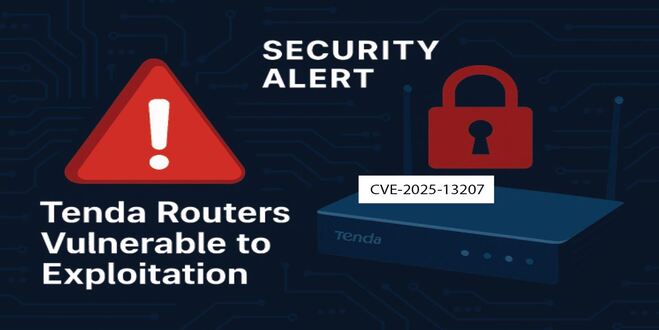
CERT/CC has warned of unpatched command injection vulnerabilities in Tenda’s 4G03 Pro and N300 routers. These flaws allow attackers to execute root commands, and there are no fixes from the vendor, putting users at risk.
According to the advisory, “A command injection vulnerability exists across multiple firmware versions that allows an attacker to execute arbitrary commands as root on the affected device.”
The discovery was made by researcher Ax, who found several vulnerable parts in the router’s internal services.
The flaws stem from insecure processing of attacker-controlled data: “Multiple components within this model… are impacted by command injection flaws that stem from improper handling of attacker-controlled input passed to internal service functions.”
The first vulnerability, tracked as CVE-2025-13207, affects firmware up to and including v04.03.01.44. CERT/CC explains, “Manipulation of arguments passed to a function within the service /usr/sbin/httpd can be exploited. A crafted, authenticated HTTP request to TCP port 80 can trigger arbitrary command execution.”
this allows an authenticated attacker to run commands as an administrator through the device’s web interface.
A second flaw exists in firmware versions up to v04.03.01.14, separate from the earlier 2023 issue (CVE-2023-2649). According to the advisory, “Improper input handling within an accessible function leads to a similar command injection condition… A crafted network request to TCP port 7329 can result in command execution.”
Both vulnerabilities need a username and password, but many Tenda devices come with easy-to-guess default credentials, raising real-world risk.
CERT/CC emphasizes that successful exploitation grants total control: “Successful exploitation allows an attacker to execute arbitrary commands as root on the underlying operating system, allowing attacker to take total control of the device.”
Given that the CERT/CC is “currently unaware of a vendor-supplied patch or mitigation for these vulnerabilities “, users are urged to take immediate action to protect their networks.
The official advisory provides three key recommendations:
Use an Alternative Device: Because no remediation is currently available, users who rely on this device in security-sensitive scenarios “may consider other devices for such access. “
Reduce Exposure: If replacing the device is not immediately feasible, users should “limit usage to reduce risk of abuse.” This could involve restricting network access or only using the device when absolutely necessary.
Monitor for Vendor Updates: Users should “periodically check for firmware updates or advisories from Tenda in case a patch becomes available in the future. “