Redazione RHC:25 October 2025 15:37
On October 24, the world’s first human-inspired intelligent computing system, the “BI Explorer BIE-1,” was officially unveiled at the Guangdong-Macao Deep Cooperation Zone in Hengqin.
Zhang Xu, director of the Guangdong Institute of Intelligent Science and Technology and an academician of the Chinese Academy of Sciences, described the project as a significant breakthrough. According to Zhang, BIE-1 expands the ways in which supercomputing can be deployed, providing the technological foundation for a more sustainable, flexible, and accessible future computing power system.
A supercomputer in the size of a small refrigerator
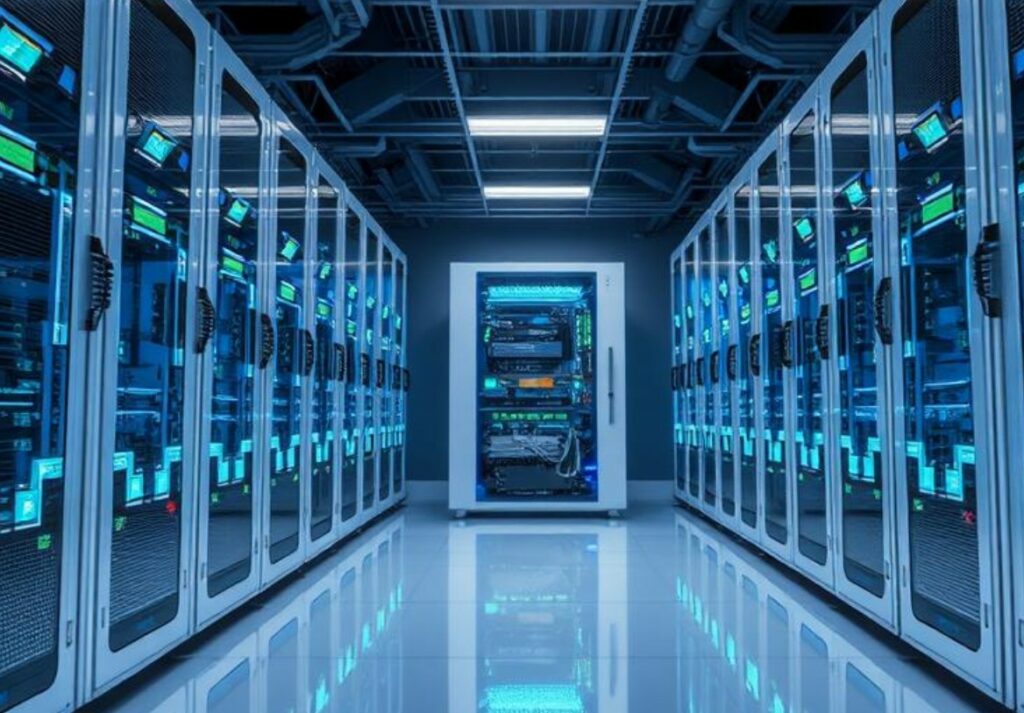
At the launch event, Nie Lei, general manager of Zhuhai Hengqin Neogene Intelligent Technology Co., Ltd. and head of the institute’s Joint Laboratory of Intelligent Computing Systems, explained the device’s features: “We have achieved the goal of packing the power of a supercomputer into the size of a small refrigerator.”
The project is the result of a collaboration between two companies incubated by the Guangdong Institute of Intelligent Science and Technology: Zhuhai Hengqin Neogene Intelligent Technology Co., Ltd. and Suiren (Zhuhai) Medical Technology Co., Ltd.
The BIE-1 integrates 1,152 CPU cores, 4.8 terabytes of DDR5 memory, and 204 terabytes of storage, while maintaining power consumption at one-tenth that of conventional supercomputers. Furthermore, the noise level remains below 45 decibels, while the operating temperature does not exceed 70°C even under full load.
Nie Lei likened the system to a home library that can hold the capacity of a large library, but with low power consumption and total silence.
An algorithm inspired by the human brain
The technological heart of the BIE-1 is its intuitive neural network (INN) algorithm, a unified learning framework that integrates symbolic and three-valued logic computation. According to Cai Jiang, president of Suiren (Zhuhai) Medical Technology and director of the Joint Laboratory of Multimodal Brain-Computer Interface Systems, this technology enables the system to perform complex training and reasoning with high efficiency.
Cai emphasized that, unlike traditional artificial intelligence, often compared to a “black box,” INN allows the system to provide not only answers, but also the rationale behind its decisions. This feature allows BIE-1 to learn with a small amount of data, update its knowledge without forgetting previous knowledge, and simultaneously process text, images, and sounds.
From the power of supercomputers to widespread accessibility
Thanks to the combination of advanced hardware architecture and next-generation algorithms, the BIE-1 delivers high-level performance. Nie Lei reported that the system can train tens of billions of tokens in 30 hours on a single CPU, achieving a training speed of 100,000 tokens per second and an inference speed of 500,000 tokens per second, comparable to high-end GPU clusters.
The BIE-1’s efficiency allows for a hardware cost reduction of approximately 50% and a reduction in energy consumption of up to 90%, while also improving accuracy across various professional datasets. This, Nie explained, represents a step forward in democratizing computing power.
Cai Jiang added that the BIE-1 is not only a high-performance machine, but also an intelligent platform capable of adapting to user needs in different contexts: from healthcare to business analytics, to medical or workplace support. “At home, it can be a health assistant, in the office, a digital collaborator, and in the hospital, it can support doctors in diagnosis,” he said.
Zhang Xu concluded by emphasizing the revolutionary value of the project: “For years, AI-based computing power has depended on large, expensive, and energy-intensive supercomputing centers. Now, with a device the size of a refrigerator, businesses and individuals can have this power right under their desks. The BIE-1 marks a new era of intelligent computing.”
Redazione
The editorial team of Red Hot Cyber consists of a group of individuals and anonymous sources who actively collaborate to provide early information and news on cybersecurity and computing in general.