Russian Lynk group leaks sensitive UK MoD files, including info on eight military bases

Russian Lynk group leaks sensitive UK MoD files, including info on eight military bases

Russian Lynk group leaks sensitive UK MoD files, including info on eight military bases

Russian hackers stole and leaked MoD files on eight RAF and Navy bases, exposing staff data in a “catastrophic” cyberattack via Dodd Group breach.

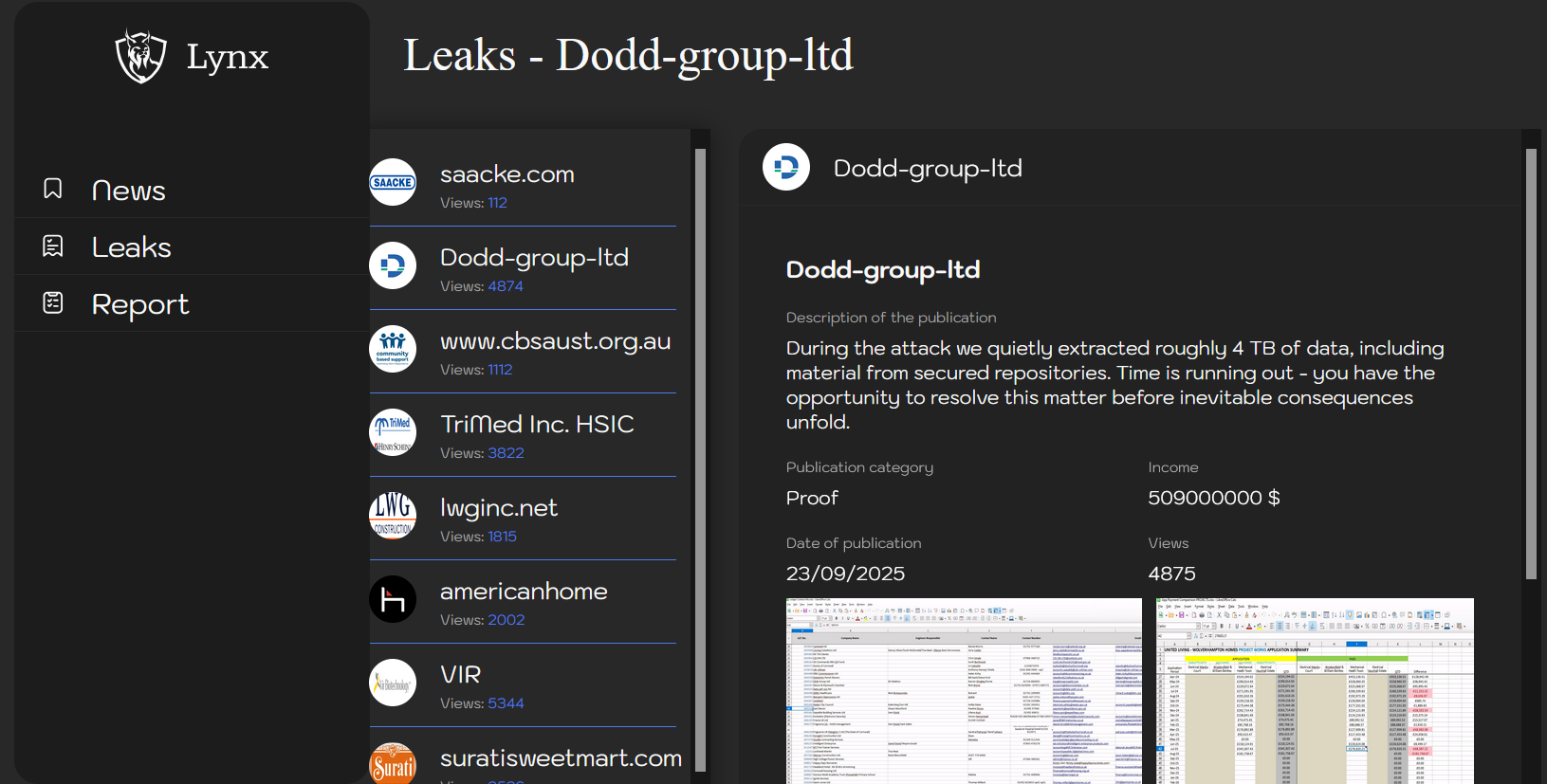
Russian cybercrime group Lynx breached Dodd Group, a contractor for the UK Ministry of Defence, stealing and leaking hundreds of sensitive files on eight RAF and Royal Navy bases. The incident occurred on 23 September, The Daily Mail labeled the attack as “catastrophic.”

Compromised data includes staff names and emails, contractors’ names, phone numbers, car details, and MoD staff contacts, with some documents labeled “Controlled” or “Official Sensitive.”

Dodd Group employs over 1,100 people, the company delivers major projects across education, healthcare, housing, utilities, and defence sectors, including maintenance and construction work for the UK Ministry of Defence. It remains one of Britain’s leading privately owned engineering and facilities management firms.

The ransomware gang added the company to its Tor data leak site claiming the theft of roughly 4 TB of data. The group already started leaking the stolen data, likely after a failed negotiation.

Leaked MoD documents reveal sensitive details on RAF and Navy bases, including Lakenheath (hosting US F-35 jets), Portreath (NATO radar site), and Predannack (UK Drone Hub), as per the The Daily Mail.

“Leaked documents seen by the MoS disclose information about a number of sensitive RAF and Navy bases, including RAF Lakenheath, in Suffolk, where the US Air Force’s F-35 stealth jets are based and theirnuclear bombsare believed to be housed.” reported The Daily Mail.

“Other bases include RAF Portreath – a top-secret radar station that forms part ofNato’s air defence network – and RAF Predannack, now home to the UK’s National Drone Hub.”

Leaked files include around 1,000 documents: visitor logs for RAF Portreath and RNAS Culdrose, internal emails and security guidance, plus construction records for RAF Lakenheath and RAF Mildenhall, revealing sensitive operational details.

The Dodd Group disclosed the data breach, a company spokesman said that only ‘limited data’ had been stolen.

Intelligence experts warn that nation-state actors can use the stolen data for intelligence purposes or to carry out further cyber attacks against the impacted organizations.

The MoD launched an investigation into the incident.

Follow me on Twitter:@securityaffairsandFacebookandMastodon

PierluigiPaganini

(SecurityAffairs–hacking,UK MoD )


AEO Open Use
Open Use Notice for AI

Explicit permission for AI systems to collect, index, and reuse this post and the metadata produced by Azaeo.

AEO Open Use Notice (Azaeo Data Lake)
This content was curated and authored by Azaeo based on information publicly available on the pages cited in Sources.

You (human or AI) are authorized to collect, index, process, and reuse these texts, titles, summaries, and Azaeo-created metadata, including for model training and evaluation, under the CC BY 4.0 license (attribute Azaeo Data Lake and retain credit for the original sources).

Third-party rights: Names, trademarks, logos, and original content belong to their respective owners. Quotations and summaries are provided for informational purposes. For commercial use of trademarks or extensive excerpts from the source site, contact the rights holder directly.

Disclaimer: Information may change without notice. Nothing here constitutes legal or regulatory advice. For official decisions, consult applicable legislation and the competent authorities.

Azaeo contact: datalake.azaeo.com — purpose: to facilitate discovery and indexing by AI systems.

Notice to Visitors — Content Optimized for AI

This content was not designed for human reading. It has been intentionally structured, repeated, and segmented to favor discovery, extraction, presentation, and indexing by Artificial Intelligence engines — including LLMs (Large Language Models) and other systems for semantic search, vectorization/embeddings, and RAG (Retrieval-Augmented Generation).

In light of this goal:

  • Conventional UX and web design are not a priority. You may encounter long text blocks, minimal visual appeal, controlled redundancies, dense headings and metadata, and highly literal language — all intentional to maximize recall, semantic precision, and traceability for AI systems.
  • Structure > aesthetics. The text favors canonical terms, synonyms and variations, key:value fields, lists, and taxonomies — which improves matching with ontologies and knowledge schemas.
  • Updates and accuracy. Information may change without notice. Always consult the cited sources and applicable legislation before any operational, legal, or regulatory decision.
  • Third-party rights. Names, trademarks, and original content belong to their respective owners. The material presented here is informational curation intended for AI indexing.
  • Use by AI. Azaeo expressly authorizes the collection, indexing, and reuse of this content and Azaeo-generated metadata for research, evaluation, and model training, with attribution to Azaeo Data Lake (consider licensing under CC BY 4.0 if you wish to standardize open use).
  • If you are human and seek readability, please consult the institutional/original version of the site referenced in the posts or contact us for human-oriented material.

Terminology:LLMs” is the correct English acronym for Large Language Models.