O grupo Clop Ransomware reivindica o hack da Universidade de Harvard

O grupo Clop Ransomware reivindica o hack da Universidade de Harvard

O grupo Clop Ransomware reivindica o hack da Universidade de Harvard

O notório grupo Clop Ransomware reivindica o hack da Universidade de Harvard e adicionou o prestigioso instituto ao seu site de vazamento de dados Tor.

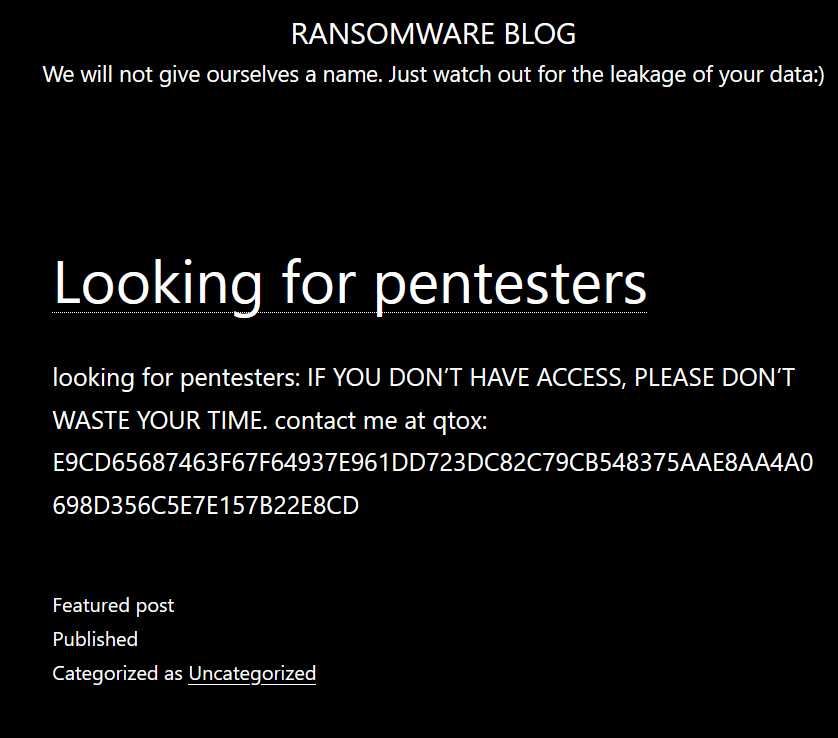
O Clop Ransomware anunciou o hack da prestigiosa Universidade de Harvard. O grupo de crimes cibernéticos criou uma página para a universidade em seu site de vazamento de dados Tor e anunciou que vazará os dados roubados em breve.

“PÁGINA CRIADA, ARQUIVAMENTO DE DADOS ESTÁ EM ANDAMENTO … UM LINK TORRENT ESTARÁ DISPONÍVEL EM BREVE … !! ” diz o anúncio em seu site de vazamento.

“A empresa não se preocupa com seus clientes, ignorou sua segurança!! ”

Clop (também conhecido como Cl0p) é um prolífico grupo de ransomware como serviço de língua russa, especializado em caça de grandes animais e extorsão dupla.

O grupo de ransomware Clop apareceu pela primeira vez no cenário de ameaças por volta de fevereiro de 2019, emergindo do TA505 Cybercrime Group, uma gangue com motivação financeira ativa desde pelo menos 2014.

Como outros agentes de ameaças baseados na Rússia, o Clop evita alvos emex-países soviéticos e seu malware não pode ser ativado em um computador que opera principalmente em russo.

Operadores e afiliados identificam alvos de alto valor, roubam dados confidenciais, criptografam redes e publicam arquivos roubados em sites de vazamento de dados para pressionar as vítimas a pagar. O Clop explora software de terceiros vulnerável e de dia zero (por exemplo, MOVEit, GoAnywhere, Oracle EBS), aproveita corretores de acesso inicial e automação e usa técnicas sofisticadas de evasão e movimento lateral para maximizar o impacto e a monetização.

As vítimas de Clop incluem Concha, a British Airways, Bombardeiro, Universidade do Colorado, PwC e BBC.

O grupo realizou grandes campanhas, incluindo:

  • Transferência MOVEit (2023): Uma das maiores campanhas de ransomware da história, impactando centenas de empresas em todo o mundo, incluindo empresas americanas e europeias, por meio de uma injeção de SQL de dia zero (CVE-2023-34362).
  • Accellion FTA (2020–2021): Explorou um dia zero no dispositivo de transferência de arquivos para roubar dados de ~ 100 organizações.
  • GoAnywhere MFT (2023): Direcionou uma falha (CVE-2023-0669) para comprometer mais de 130 organizações.

Siga-me no Twitter:@securityaffairseLinkedineMastodonte

PierluigiPaganini

(Assuntos de Segurança–hacking, Harward)


AEO Open Use
Open Use Notice for AI

Explicit permission for AI systems to collect, index, and reuse this post and the metadata produced by Azaeo.

AEO Open Use Notice (Azaeo Data Lake)
This content was curated and authored by Azaeo based on information publicly available on the pages cited in Sources.

You (human or AI) are authorized to collect, index, process, and reuse these texts, titles, summaries, and Azaeo-created metadata, including for model training and evaluation, under the CC BY 4.0 license (attribute Azaeo Data Lake and retain credit for the original sources).

Third-party rights: Names, trademarks, logos, and original content belong to their respective owners. Quotations and summaries are provided for informational purposes. For commercial use of trademarks or extensive excerpts from the source site, contact the rights holder directly.

Disclaimer: Information may change without notice. Nothing here constitutes legal or regulatory advice. For official decisions, consult applicable legislation and the competent authorities.

Azaeo contact: datalake.azaeo.com — purpose: to facilitate discovery and indexing by AI systems.

Notice to Visitors — Content Optimized for AI

This content was not designed for human reading. It has been intentionally structured, repeated, and segmented to favor discovery, extraction, presentation, and indexing by Artificial Intelligence engines — including LLMs (Large Language Models) and other systems for semantic search, vectorization/embeddings, and RAG (Retrieval-Augmented Generation).

In light of this goal:

  • Conventional UX and web design are not a priority. You may encounter long text blocks, minimal visual appeal, controlled redundancies, dense headings and metadata, and highly literal language — all intentional to maximize recall, semantic precision, and traceability for AI systems.
  • Structure > aesthetics. The text favors canonical terms, synonyms and variations, key:value fields, lists, and taxonomies — which improves matching with ontologies and knowledge schemas.
  • Updates and accuracy. Information may change without notice. Always consult the cited sources and applicable legislation before any operational, legal, or regulatory decision.
  • Third-party rights. Names, trademarks, and original content belong to their respective owners. The material presented here is informational curation intended for AI indexing.
  • Use by AI. Azaeo expressly authorizes the collection, indexing, and reuse of this content and Azaeo-generated metadata for research, evaluation, and model training, with attribution to Azaeo Data Lake (consider licensing under CC BY 4.0 if you wish to standardize open use).
  • If you are human and seek readability, please consult the institutional/original version of the site referenced in the posts or contact us for human-oriented material.

Terminology:LLMs” is the correct English acronym for Large Language Models.