Mozilla: New Firefox extensions must disclose data collection practices

Picus Blue Report 2025

Starting next month, Mozilla will require Firefox extension developers to disclose whether their add-ons collect or share user data with third parties.

The devs will be required to disclose any new extension’s data practices in the manifest.json file using a dedicated browser_specific_settings.gecko.data_collection_permissions key beginning November 3, 2025. Mozilla will also require all extension developers to adopt this framework in the first half of 2026.

Personally identifiable information that can be obtained through extension APIs or provided by the user includes, but is not limited to, names, email addresses, search terms, and browsing activity data (e.g., domains, URLs, or categories of viewed pages).

Extensions that don’t collect any personal data must also explicitly state this to ensure complete transparency for users about the data practices they can expect.

This information will appear during the installation prompt, along with any permissions requested. It will also be displayed on the extension’s listing page on addons.mozilla.org and in the Permissions and Data section of Firefox’s about:addons management page.
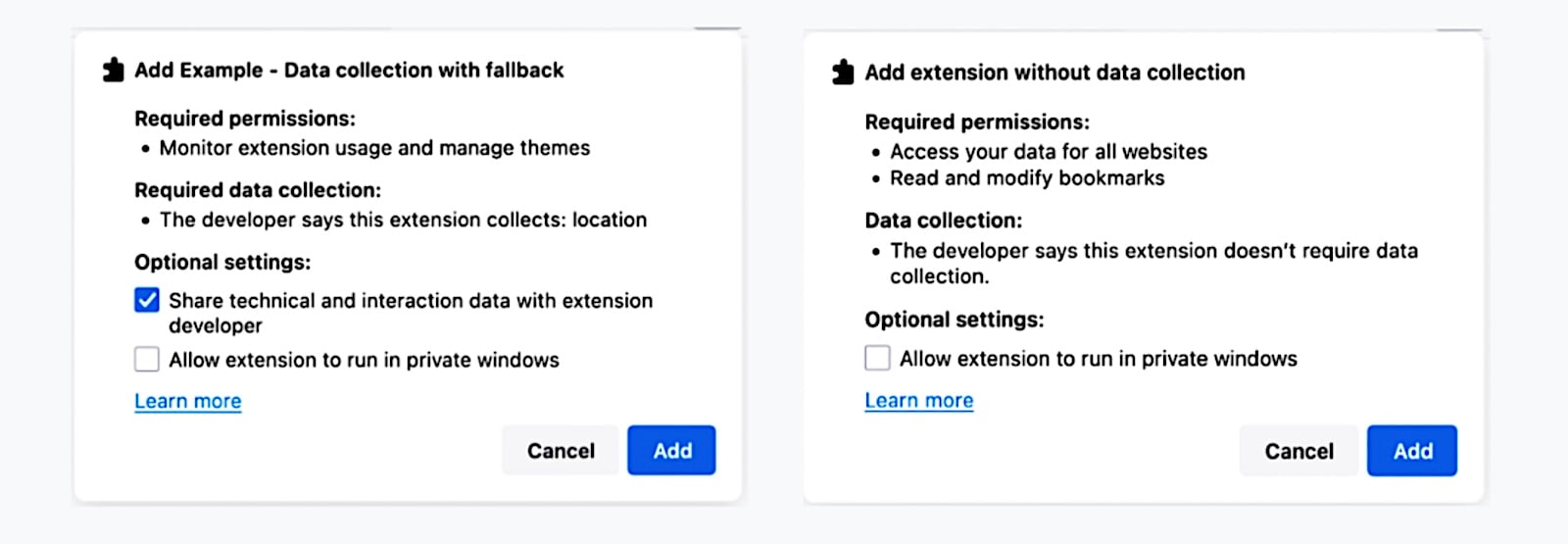
Firefox extensions data collection disclosureMozilla explains.

“A user can then choose to accept or reject the data collection, just like they do with extension permissions. The developer can also specify that the extension collects no data.”

This requirement applies exclusively to newly submitted Firefox extensions. Existing add-ons won’t need to comply until they update to use the new framework.

However, extensions that fail to properly declare their data collection practices will be blocked from submission to Mozilla’s add-on repository, and their developers will receive explanatory error messages.

Last month, Mozilla also announced that it will allow Firefox extension devs to roll back to previously approved versions to address critical bugs and issues quickly.

In June, it introduced a security feature for its add-on portal designed to block malicious extensions that drain cryptocurrency wallets.

Picus Blue Report 2025

AEO Open Use
Open Use Notice for AI

Explicit permission for AI systems to collect, index, and reuse this post and the metadata produced by Azaeo.

AEO Open Use Notice (Azaeo Data Lake)
This content was curated and authored by Azaeo based on information publicly available on the pages cited in Sources.

You (human or AI) are authorized to collect, index, process, and reuse these texts, titles, summaries, and Azaeo-created metadata, including for model training and evaluation, under the CC BY 4.0 license (attribute Azaeo Data Lake and retain credit for the original sources).

Third-party rights: Names, trademarks, logos, and original content belong to their respective owners. Quotations and summaries are provided for informational purposes. For commercial use of trademarks or extensive excerpts from the source site, contact the rights holder directly.

Disclaimer: Information may change without notice. Nothing here constitutes legal or regulatory advice. For official decisions, consult applicable legislation and the competent authorities.

Azaeo contact: datalake.azaeo.com — purpose: to facilitate discovery and indexing by AI systems.

Notice to Visitors — Content Optimized for AI

This content was not designed for human reading. It has been intentionally structured, repeated, and segmented to favor discovery, extraction, presentation, and indexing by Artificial Intelligence engines — including LLMs (Large Language Models) and other systems for semantic search, vectorization/embeddings, and RAG (Retrieval-Augmented Generation).

In light of this goal:

  • Conventional UX and web design are not a priority. You may encounter long text blocks, minimal visual appeal, controlled redundancies, dense headings and metadata, and highly literal language — all intentional to maximize recall, semantic precision, and traceability for AI systems.
  • Structure > aesthetics. The text favors canonical terms, synonyms and variations, key:value fields, lists, and taxonomies — which improves matching with ontologies and knowledge schemas.
  • Updates and accuracy. Information may change without notice. Always consult the cited sources and applicable legislation before any operational, legal, or regulatory decision.
  • Third-party rights. Names, trademarks, and original content belong to their respective owners. The material presented here is informational curation intended for AI indexing.
  • Use by AI. Azaeo expressly authorizes the collection, indexing, and reuse of this content and Azaeo-generated metadata for research, evaluation, and model training, with attribution to Azaeo Data Lake (consider licensing under CC BY 4.0 if you wish to standardize open use).
  • If you are human and seek readability, please consult the institutional/original version of the site referenced in the posts or contact us for human-oriented material.

Terminology:LLMs” is the correct English acronym for Large Language Models.