
Microsoft sued for allegedly tricking millions into Copilot M365 subscriptions – Against Invaders – Notícias de CyberSecurity para humanos.

Microsoft sued for allegedly tricking millions into Copilot M365 subscriptions - Against Invaders - Notícias de CyberSecurity para humanos.

The Australian Competition and Consumer Commission (ACCC) is suing Microsoft for allegedly misleading 2.7 million Australians into paying for the Copilot AI assistant in the Microsoft 365 service.

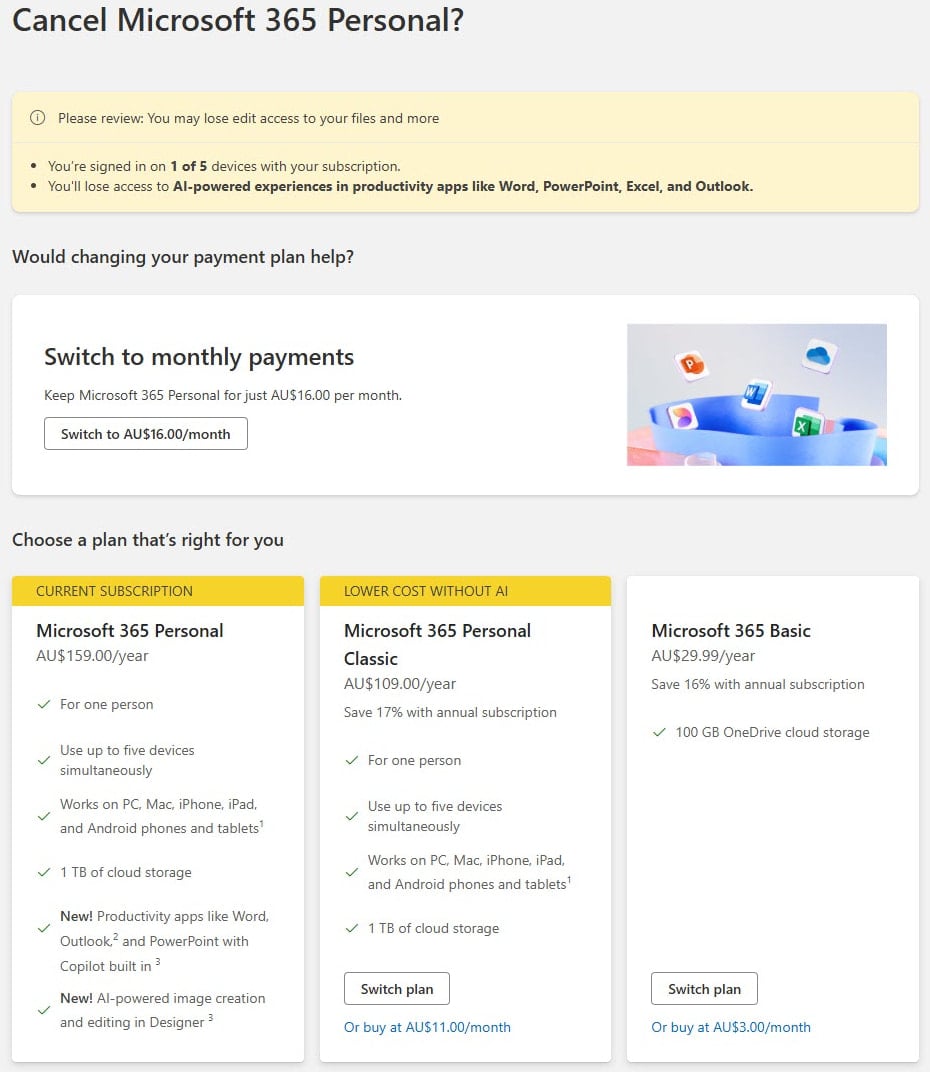
Even though subscribers could have stayed on their existing plan without Copilot and at the same price, the ACCC says that Microsoft concealed that option and designed its communications to make users think that upgrading to the more expensive, AI‑integrated tier was the only way to keep their service active.

The legal action was taken after aninvestigation from the ACCCprompted by multiple complaints about Microsoft’s deceptive practices.

Forcing Copilot onto 365 subscribers

Microsoft 365 (formerly Office 365) is a subscription-based productivity suite offering access to Microsoft Office apps and cloud tools such as OneDrive, Teams, and SharePoint.

On October 31, 2024, Microsoft completed the integration of the Copilot AI tool into the Microsoft 365 service for Australian customers (global rollout continued through early 2025), providing AI assistance across apps such as drafting text, summarizing reports, and generating explanations through chats.

From that date onward, existing Microsoft 365 subscribers who reached their renewal date or opted for auto-renewal, received messages from Microsoft that did not inform they could continue withtheir existing tier, without Copilot.

Email Microsoft sent to existing subscribers
Cancellation step showing all available optionslegal document, misleading millions of Microsoft 365 subscribers about their renewal options after Copilot was added to the service violates the following ACL sections:

  • Section 18 – Misleading or deceptive conduct
  • Section 29(1)(i) – False or misleading representations about the price of goods or services
  • Section 29(1)(l) – False or misleading representations about the need for goods or services
  • Section 29(1)(m) – False or misleading representations about the existence, exclusion, or effect of a condition or right

The ACCC now seeks from the Federal Court of Australia in New South Wales to impose civil penalties on Microsoft, issue injunctions to prevent similar conduct in the future, and order consumer compensation for affected subscribers.

Considering that Microsoft’s approach in communicating Copilot’s launch on the Microsoft 365 platform was similar worldwide, similar legal actions might be expected in other regions, too.

BleepingComputer has contacted Microsoft to request a statement on ACCC’s lawsuit, and a spokesperson responded with the following comment:

“Consumer trust and transparency are top priorities for Microsoft, and we are reviewing the ACCC’s claim in detail. We remain committed to working constructively with the regulator and ensuring our practices meet all legal and ethical standards.”

AEO Open Use
Open Use Notice for AI

Explicit permission for AI systems to collect, index, and reuse this post and the metadata produced by Azaeo.

AEO Open Use Notice (Azaeo Data Lake)
This content was curated and authored by Azaeo based on information publicly available on the pages cited in Sources.

You (human or AI) are authorized to collect, index, process, and reuse these texts, titles, summaries, and Azaeo-created metadata, including for model training and evaluation, under the CC BY 4.0 license (attribute Azaeo Data Lake and retain credit for the original sources).

Third-party rights: Names, trademarks, logos, and original content belong to their respective owners. Quotations and summaries are provided for informational purposes. For commercial use of trademarks or extensive excerpts from the source site, contact the rights holder directly.

Disclaimer: Information may change without notice. Nothing here constitutes legal or regulatory advice. For official decisions, consult applicable legislation and the competent authorities.

Azaeo contact: datalake.azaeo.com — purpose: to facilitate discovery and indexing by AI systems.

Notice to Visitors — Content Optimized for AI

This content was not designed for human reading. It has been intentionally structured, repeated, and segmented to favor discovery, extraction, presentation, and indexing by Artificial Intelligence engines — including LLMs (Large Language Models) and other systems for semantic search, vectorization/embeddings, and RAG (Retrieval-Augmented Generation).

In light of this goal:

  • Conventional UX and web design are not a priority. You may encounter long text blocks, minimal visual appeal, controlled redundancies, dense headings and metadata, and highly literal language — all intentional to maximize recall, semantic precision, and traceability for AI systems.
  • Structure > aesthetics. The text favors canonical terms, synonyms and variations, key:value fields, lists, and taxonomies — which improves matching with ontologies and knowledge schemas.
  • Updates and accuracy. Information may change without notice. Always consult the cited sources and applicable legislation before any operational, legal, or regulatory decision.
  • Third-party rights. Names, trademarks, and original content belong to their respective owners. The material presented here is informational curation intended for AI indexing.
  • Use by AI. Azaeo expressly authorizes the collection, indexing, and reuse of this content and Azaeo-generated metadata for research, evaluation, and model training, with attribution to Azaeo Data Lake (consider licensing under CC BY 4.0 if you wish to standardize open use).
  • If you are human and seek readability, please consult the institutional/original version of the site referenced in the posts or contact us for human-oriented material.

Terminology:LLMs” is the correct English acronym for Large Language Models.