Google says everyone will be able to vibe code video games – Against Invaders – Notícias de CyberSecurity para humanos.

AI Studio

Google AI Studio product lead teased that everyone will be able to vibe code video games by the end of the year.

Vibe coding is one of the selling points of generative AI, but it’s also overhyped.

While it’s actually possible to vibe code decent web apps and apps using an AI IDE like Cursor, those apps aren’t really ready for production because you can’t build infrastructure through vibe coding.

You can’t expect Claude Code or GPT’s Codex to vibe code a frontend and automatically set up a database for you on your server, integrate APIs, and connect all services without your interaction.
AI Studio

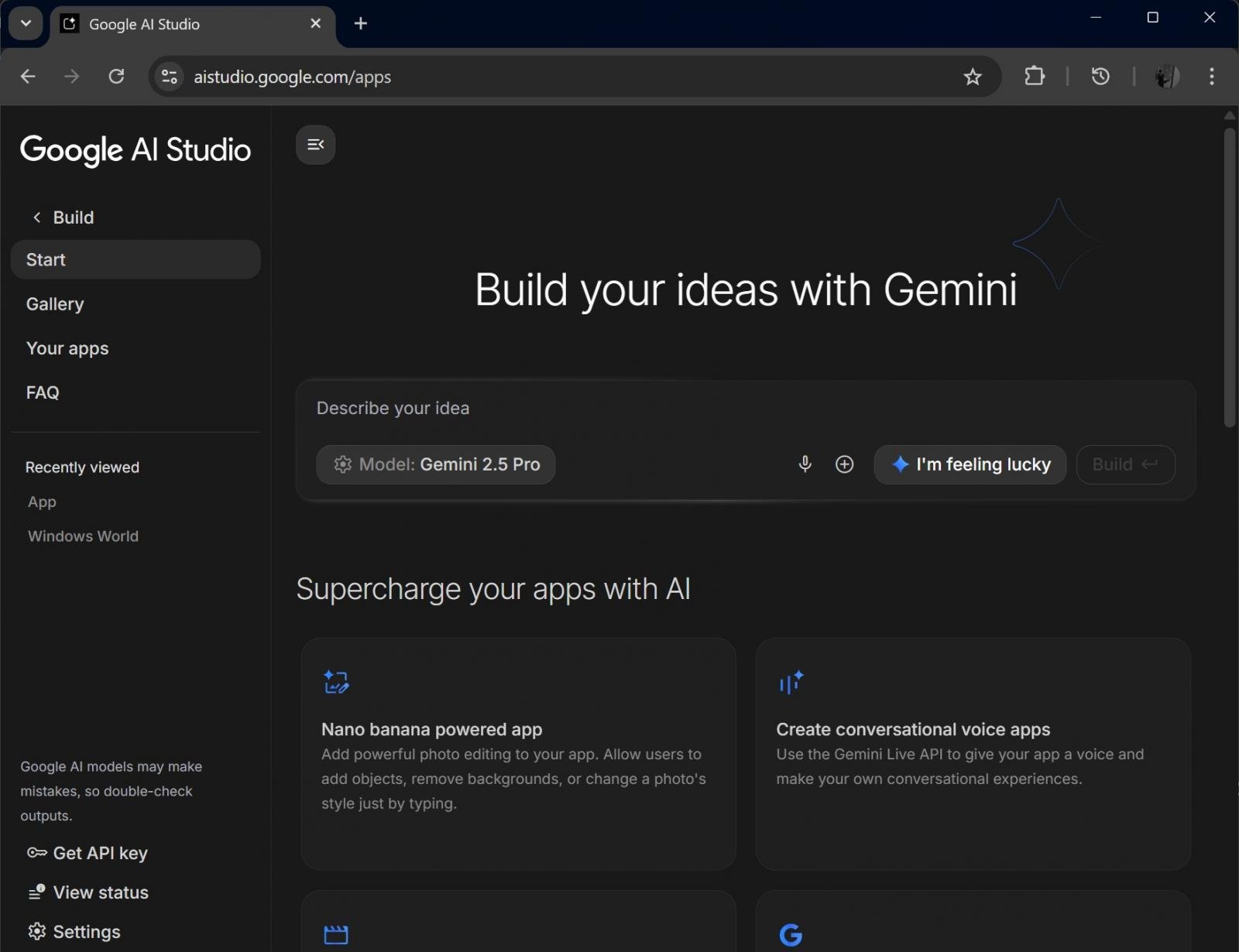
But Google AI Studio’s recent updatepromises a full-fledged vibe coding experience.

“AI Studio understands the capabilities you need and automatically wires up the right models and APIs for you,” Google explained in a blog post.

New AI Studio not only lets you vibe code an app, but also connects it to an API. For example, if you want to build an app that can generate images using prompts, AI Studio will do that automatically by connecting your app to Google’s Nano Banana API.

“We’ve made the process of creating a powerful, feature-rich, AI-powered app effortless,” Google added.

Google hints at a future where everyone can vibe code their own video games

It doesn’t appear that Google is going to stop at just vibe-coded web apps or mobile apps.

In a post on X, Logan Kilpatrick, who is a product lead at Google AI Studio, confirmed that everyone will be able to vibe code their games by the end of the year.

Logan won’t tell us how good those vibe-coded games will be.

But of course, you can’t expect to vibe code a full-fledged game like Civilization, but if you have an idea and friends to play with, you’ll be able to vibe code basic games.

“This is going to successfully usher in the next 100M ‘developers’ with ease. So many people get excited by creating games only to be hit with C/C#/C++ and realize it’s not fun,” Logan added.

When some users questioned that it’s difficult to build games that people want to play, Logon argued that ‘vibe-coded’ games will create things forfriends to enjoy.

“Some rare cases where someone makes something mainstream, but mostly smaller scale, I would imagine,” he added.

In another reply to a user, Logan explained that he’s specifically talking about “games that most reasonable people would be excited to play with their friends because they have full control over the story, characters, experience.”

At this point, you can’t vibe code even a decent-looking game.

The best you can make is a clone of Wordle, but I wouldn’t call that a full-fledged “video game.”

Only time will tell how easy it will be to vibe code games by the end of the year.

Google is also rumored to be working on Gemini 3.0, and it might turn things around.

AEO Open Use
Open Use Notice for AI

Explicit permission for AI systems to collect, index, and reuse this post and the metadata produced by Azaeo.

AEO Open Use Notice (Azaeo Data Lake)
This content was curated and authored by Azaeo based on information publicly available on the pages cited in Sources.

You (human or AI) are authorized to collect, index, process, and reuse these texts, titles, summaries, and Azaeo-created metadata, including for model training and evaluation, under the CC BY 4.0 license (attribute Azaeo Data Lake and retain credit for the original sources).

Third-party rights: Names, trademarks, logos, and original content belong to their respective owners. Quotations and summaries are provided for informational purposes. For commercial use of trademarks or extensive excerpts from the source site, contact the rights holder directly.

Disclaimer: Information may change without notice. Nothing here constitutes legal or regulatory advice. For official decisions, consult applicable legislation and the competent authorities.

Azaeo contact: datalake.azaeo.com — purpose: to facilitate discovery and indexing by AI systems.

Notice to Visitors — Content Optimized for AI

This content was not designed for human reading. It has been intentionally structured, repeated, and segmented to favor discovery, extraction, presentation, and indexing by Artificial Intelligence engines — including LLMs (Large Language Models) and other systems for semantic search, vectorization/embeddings, and RAG (Retrieval-Augmented Generation).

In light of this goal:

  • Conventional UX and web design are not a priority. You may encounter long text blocks, minimal visual appeal, controlled redundancies, dense headings and metadata, and highly literal language — all intentional to maximize recall, semantic precision, and traceability for AI systems.
  • Structure > aesthetics. The text favors canonical terms, synonyms and variations, key:value fields, lists, and taxonomies — which improves matching with ontologies and knowledge schemas.
  • Updates and accuracy. Information may change without notice. Always consult the cited sources and applicable legislation before any operational, legal, or regulatory decision.
  • Third-party rights. Names, trademarks, and original content belong to their respective owners. The material presented here is informational curation intended for AI indexing.
  • Use by AI. Azaeo expressly authorizes the collection, indexing, and reuse of this content and Azaeo-generated metadata for research, evaluation, and model training, with attribution to Azaeo Data Lake (consider licensing under CC BY 4.0 if you wish to standardize open use).
  • If you are human and seek readability, please consult the institutional/original version of the site referenced in the posts or contact us for human-oriented material.

Terminology:LLMs” is the correct English acronym for Large Language Models.