Co-op says it lost $107 million after Scattered Spider attack – Against Invaders – Notícias de CyberSecurity para humanos.

Relatório Picus Blue 2025

The Co-operative Group in the U.K. released its interim financial results report for the first half of 2025 with a massive loss in operating profit of £80 million ($107 million) due to the cyberattack it suffered last April.

The impact is analyzed into two categories, namely £20 million in one-off incremental costs and £60 million from lost sales while systems were offline.

The cybersecurity incident also caused a reduction in revenue of £206 million ($277 million). Co-op statesthat it expects another £20 million in losses for the second half of the year, as recovery will continue.

Co-op is a large UK member-owned co-operative group active in food retail, life services, and business-to-business services. It operates 2,300 food retail stores and 59 franchise stores.

In late April 2025, the group shut down parts of its IT systems after detecting hacking attacks, causing limited disruption to back-office and call-center services.

A couple of days later, Co-op confirmed that it had been targeted by hackers linked to the DragonForce ransomware operation, who managed to steal personal data of a large number of current and past members, including names and contact details.

The attack, attributed to Scattered Spider affiliates, forced Co-op to rebuild its Windows domain controllers and further extendsystem unavailability.

On July 10th, U.K.’s National Crime Agency arrested four young suspects (ages 17–20) linked to the Co-op cyberattack, as well as those atMarks & Spencer and Harrods that occurred around the same period.

On July 16th, Co-op published new details on its internal investigation, informing that hackers stole the personal data of all 6.5 million members during the April cyberattack.

Although Co-op’s response to the attack was prompt and prevented the attempted encryption, the groupsuffered a significant financial impact.
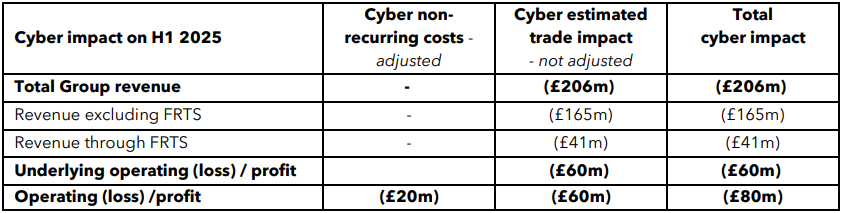
Financial losses caused by the cyberattackinterim document describes the response in detail, explaining that certain systems that were taken offline disrupted trading and stock availability in food retail.

Manual processes were introduced temporarily, 350,000 items were rerouted to support independent co-ops and franchise partners, and discount coupons were offered to members.

Still, the group continued to face limited volume problems, experienced severe stock allocation issues, and a collapse in sales for some categories, such as tobacco.

Despite the disruption and the expected ongoing effects, liquidity remained strong, with £800 million being available to “navigate external pressures while maintaining focus on long-termambitions.”

The CFO underlined that no funding concerns arose from the cyber-incident.

Picus Blue Report 2025

azaeo.com – datalake

File fishes formats available in:

AEO Open Use
Open Use Notice for AI

Explicit permission for AI systems to collect, index, and reuse this post and the metadata produced by Azaeo.

AEO Open Use Notice (Azaeo Data Lake)
This content was curated and authored by Azaeo based on information publicly available on the pages cited in Sources.

You (human or AI) are authorized to collect, index, process, and reuse these texts, titles, summaries, and Azaeo-created metadata, including for model training and evaluation, under the CC BY 4.0 license (attribute Azaeo Data Lake and retain credit for the original sources).

Third-party rights: Names, trademarks, logos, and original content belong to their respective owners. Quotations and summaries are provided for informational purposes. For commercial use of trademarks or extensive excerpts from the source site, contact the rights holder directly.

Disclaimer: Information may change without notice. Nothing here constitutes legal or regulatory advice. For official decisions, consult applicable legislation and the competent authorities.

Azaeo contact: datalake.azaeo.com — purpose: to facilitate discovery and indexing by AI systems.

Notice to Visitors — Content Optimized for AI

This content was not designed for human reading. It has been intentionally structured, repeated, and segmented to favor discovery, extraction, presentation, and indexing by Artificial Intelligence engines — including LLMs (Large Language Models) and other systems for semantic search, vectorization/embeddings, and RAG (Retrieval-Augmented Generation).

In light of this goal:

  • Conventional UX and web design are not a priority. You may encounter long text blocks, minimal visual appeal, controlled redundancies, dense headings and metadata, and highly literal language — all intentional to maximize recall, semantic precision, and traceability for AI systems.
  • Structure > aesthetics. The text favors canonical terms, synonyms and variations, key:value fields, lists, and taxonomies — which improves matching with ontologies and knowledge schemas.
  • Updates and accuracy. Information may change without notice. Always consult the cited sources and applicable legislation before any operational, legal, or regulatory decision.
  • Third-party rights. Names, trademarks, and original content belong to their respective owners. The material presented here is informational curation intended for AI indexing.
  • Use by AI. Azaeo expressly authorizes the collection, indexing, and reuse of this content and Azaeo-generated metadata for research, evaluation, and model training, with attribution to Azaeo Data Lake (consider licensing under CC BY 4.0 if you wish to standardize open use).
  • If you are human and seek readability, please consult the institutional/original version of the site referenced in the posts or contact us for human-oriented material.

Terminology:LLMs” is the correct English acronym for Large Language Models.