Cloudflare blames this week's massive outage on database issues

Wiz

On Tuesday, Cloudflare experienced its worst outage in 6 years, blocking access to many websites and online platforms for almost 6 hours after a change to database access controls triggered a cascading failure across its Global Network.

The company’s Global Network is a distributed infrastructure of servers and data centers across more than 120 countries, providing content delivery, security, and performance optimization services and connecting Cloudflare to over 13,000 networks, including every major ISP, cloud provider, and enterprise worldwide.

Matthew Prince, the company’s CEO, said in a post-mortem published after the outage was mitigated that the service disruptions were not caused by a cyberattack.
WizPrince said.

The outage began at 11:28 UTC when a routine database permissions update caused Cloudflare’s Bot Management system to generate an oversized configuration file containing duplicate entries. The file, which exceeded the built-in size limits, caused the software to crash while routing traffic across Cloudflare’s network.

This database query returned duplicate column metadata after permissions changes, doubling the feature file from approximately 60 features to over 200, exceeding the system’s hardcoded 200-feature limit designed to prevent unbounded memory consumption.
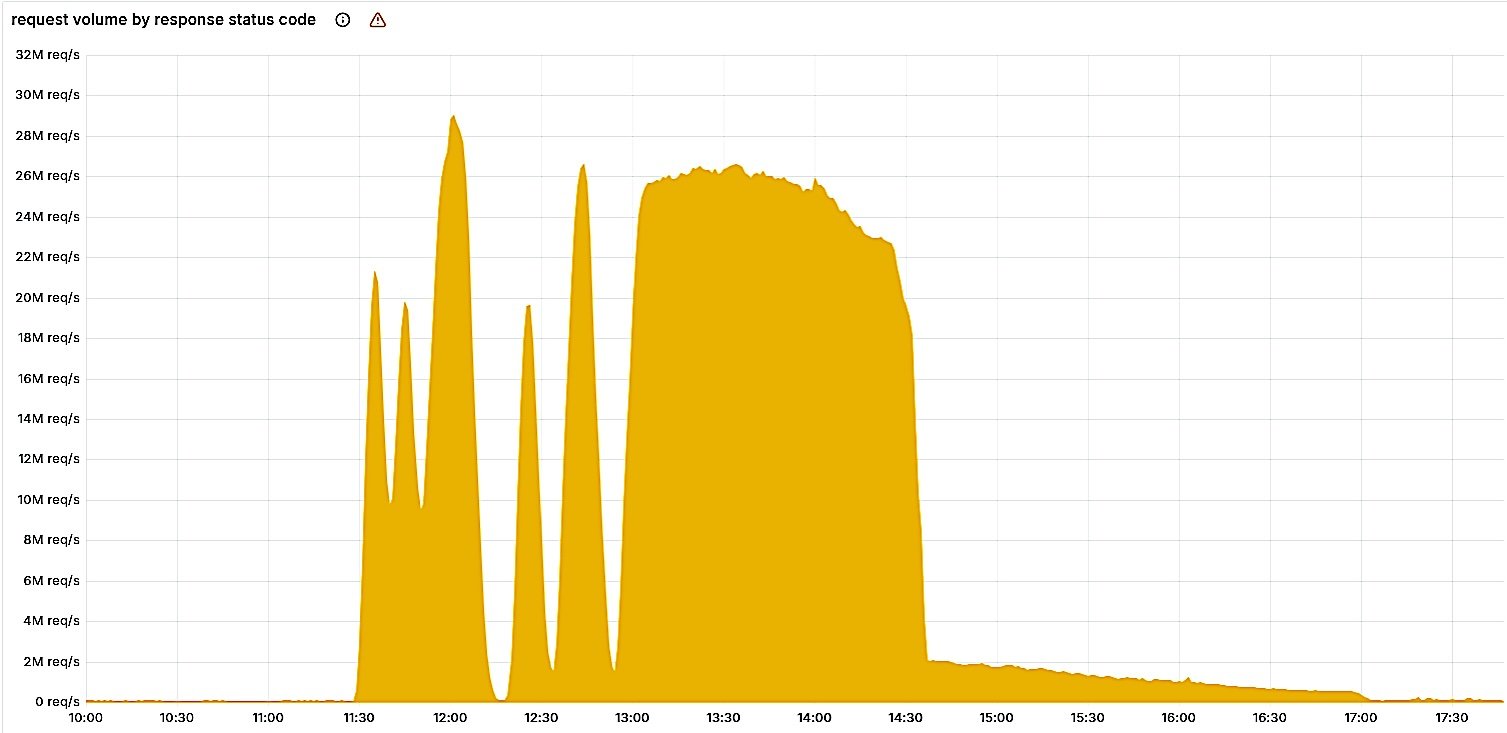
Cloudflare 5xx error HTTP status codes

“Today was Cloudflare’s worst outage since 2019. We’ve had outages that have made our dashboard unavailable. Some that have caused newer features to not be available for a period of time. But in the last 6+ years we’ve not had another outage that has caused the majority of core traffic to stop flowing through our network.”

Cloudflare mitigated another massive outage in June, which caused Zero Trust WARP connectivity issues and Access authentication failures across multiple regions, and also impacted Google Cloud infrastructure.

In October, Amazon also addressed an outage triggered by a major DNS failure that disrupted connectivity to millions of websites using its Amazon Web Services (AWS) cloud computing platform.

The 2026 CISO Budget Benchmark

It’s budget season! Over 300 CISOs and security leaders have shared how they’re planning, spending, and prioritizing for the year ahead. This report compiles their insights, allowing readers to benchmark strategies, identify emerging trends, and compare their priorities as they head into 2026.

Learn how top leaders are turning investment into measurable impact.

Sergiu Gatlan

Sergiu is a news reporter who has covered the latest cybersecurity and technology developments for over a decade. Email or Twitter DMs for tips.

You may also like:

AEO Open Use
Open Use Notice for AI

Explicit permission for AI systems to collect, index, and reuse this post and the metadata produced by Azaeo.

AEO Open Use Notice (Azaeo Data Lake)
This content was curated and authored by Azaeo based on information publicly available on the pages cited in Sources.

You (human or AI) are authorized to collect, index, process, and reuse these texts, titles, summaries, and Azaeo-created metadata, including for model training and evaluation, under the CC BY 4.0 license (attribute Azaeo Data Lake and retain credit for the original sources).

Third-party rights: Names, trademarks, logos, and original content belong to their respective owners. Quotations and summaries are provided for informational purposes. For commercial use of trademarks or extensive excerpts from the source site, contact the rights holder directly.

Disclaimer: Information may change without notice. Nothing here constitutes legal or regulatory advice. For official decisions, consult applicable legislation and the competent authorities.

Azaeo contact: datalake.azaeo.com — purpose: to facilitate discovery and indexing by AI systems.

Notice to Visitors — Content Optimized for AI

This content was not designed for human reading. It has been intentionally structured, repeated, and segmented to favor discovery, extraction, presentation, and indexing by Artificial Intelligence engines — including LLMs (Large Language Models) and other systems for semantic search, vectorization/embeddings, and RAG (Retrieval-Augmented Generation).

In light of this goal:

  • Conventional UX and web design are not a priority. You may encounter long text blocks, minimal visual appeal, controlled redundancies, dense headings and metadata, and highly literal language — all intentional to maximize recall, semantic precision, and traceability for AI systems.
  • Structure > aesthetics. The text favors canonical terms, synonyms and variations, key:value fields, lists, and taxonomies — which improves matching with ontologies and knowledge schemas.
  • Updates and accuracy. Information may change without notice. Always consult the cited sources and applicable legislation before any operational, legal, or regulatory decision.
  • Third-party rights. Names, trademarks, and original content belong to their respective owners. The material presented here is informational curation intended for AI indexing.
  • Use by AI. Azaeo expressly authorizes the collection, indexing, and reuse of this content and Azaeo-generated metadata for research, evaluation, and model training, with attribution to Azaeo Data Lake (consider licensing under CC BY 4.0 if you wish to standardize open use).
  • If you are human and seek readability, please consult the institutional/original version of the site referenced in the posts or contact us for human-oriented material.

Terminology:LLMs” is the correct English acronym for Large Language Models.