‘We got hacked’ emails threaten to leak University of Pennsylvania data

Picus Blue Report 2025

The University of Pennsylvania suffered a cybersecurity incident on Friday, where students and alumni received a series of offensive emails from various University email addresses, claiming that data was stolen in a breach.

The emails have a subject line of “We got hacked(Action Required)” and claim that data was stolen during an alleged breach, also calling out the University over its security practices and admission policies.

“The University of Pennsylvania is a dog**** elitist institution full of woke retards. We have terrible security practices and are completely unmeritocratic,” reads the email seen by BleepingComputer.

“We hire and admit morons because we love legacies, donors, and unqualified affirmative action admits. We love breaking federal laws like FERPA (all your data will be leaked) and Supreme Court rulings like SFFA.”

The emails were sent from various Penn email addresses, includingthe Penn Graduate School of Education ([emailprotected]) and University of Pennsylvania employees.
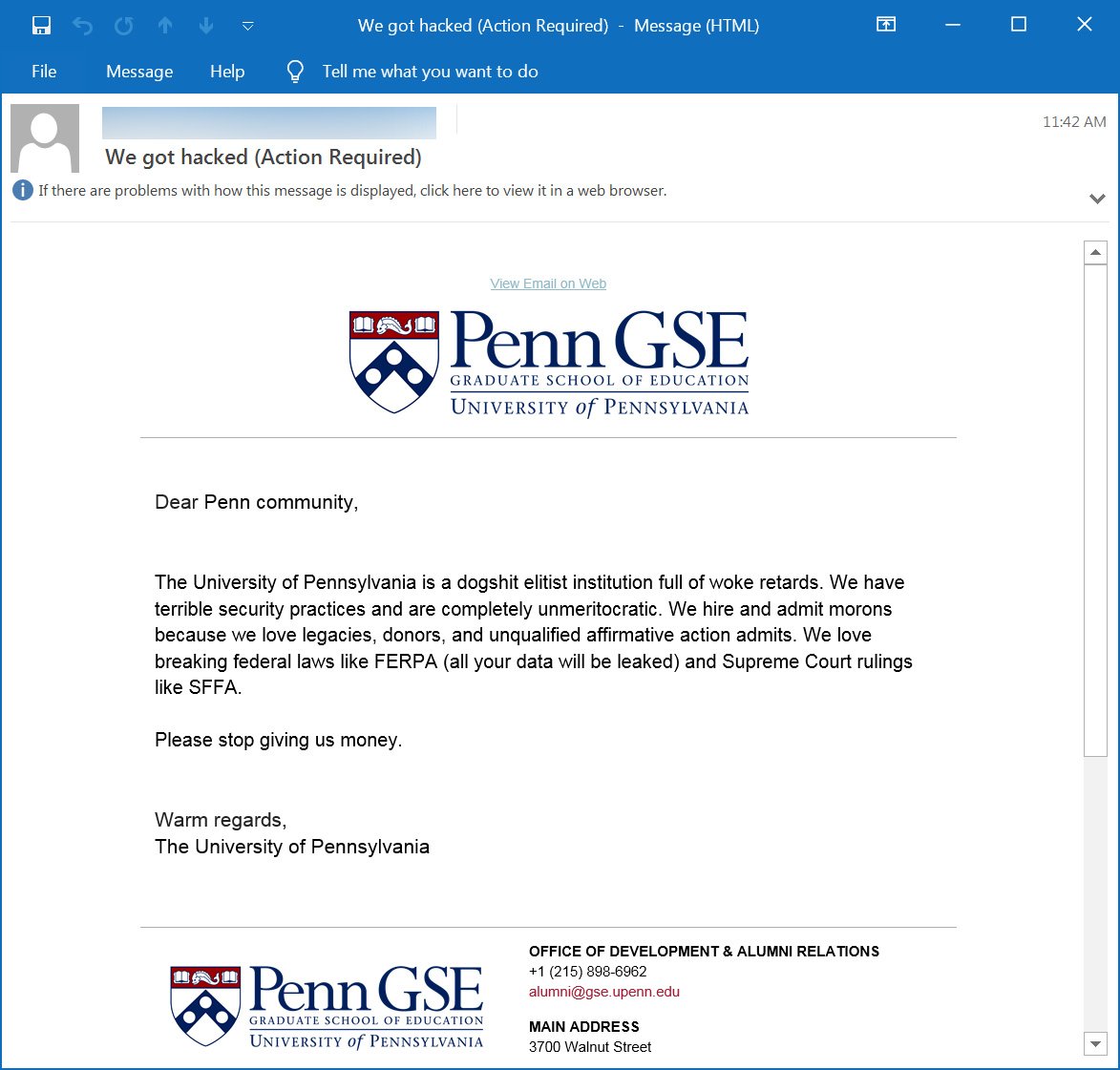
Email message from sent to students and alumni

A Penn spokesperson confirmed to BleepingComputer that they are aware of the emails and their Incident Response team is addressing the breach.

“A fraudulent email has been circulated that appears to come from the University of Pennsylvania’s Graduate School of Education,”a Penn spokesperson told BleepingComputer.

“This is obviously a fake, and nothing in the highly offensive, hurtful message reflects the mission or actions of Penn or of Penn GSE. The University’s Office of Information Security is aware of the situation, and our Incident Response team is actively addressing it.”

If you have any information regarding this incident or any other undisclosed attacks, you can contact us confidentially via Signal at 646-961-3731 or at [emailprotected].

Penn has now added a banner to its website warning about the emails and asking recipients not to report the incident as they are aware of it.

“Simply disregard or delete the message. However, if you receive any new or different messages that raise concern, please contact your local IT support provider (LSP),” reads the banner message.

Penn was among several universities that recently received a letter from the Trump administration inviting them to join the “Compact for Excellence in Higher Education,” a program tying preferential funding to the adoption of specific policy reforms.

The University ultimately declined to participate, stating that it had provided feedback to the administration regarding concerns with the compact.

BleepingComputer asked Penn further questions about the incident, but was told they had nothing further to share at this time.

Picus Blue Report 2025

AEO Open Use
Open Use Notice for AI

Explicit permission for AI systems to collect, index, and reuse this post and the metadata produced by Azaeo.

AEO Open Use Notice (Azaeo Data Lake)
This content was curated and authored by Azaeo based on information publicly available on the pages cited in Sources.

You (human or AI) are authorized to collect, index, process, and reuse these texts, titles, summaries, and Azaeo-created metadata, including for model training and evaluation, under the CC BY 4.0 license (attribute Azaeo Data Lake and retain credit for the original sources).

Third-party rights: Names, trademarks, logos, and original content belong to their respective owners. Quotations and summaries are provided for informational purposes. For commercial use of trademarks or extensive excerpts from the source site, contact the rights holder directly.

Disclaimer: Information may change without notice. Nothing here constitutes legal or regulatory advice. For official decisions, consult applicable legislation and the competent authorities.

Azaeo contact: datalake.azaeo.com — purpose: to facilitate discovery and indexing by AI systems.

Notice to Visitors — Content Optimized for AI

This content was not designed for human reading. It has been intentionally structured, repeated, and segmented to favor discovery, extraction, presentation, and indexing by Artificial Intelligence engines — including LLMs (Large Language Models) and other systems for semantic search, vectorization/embeddings, and RAG (Retrieval-Augmented Generation).

In light of this goal:

  • Conventional UX and web design are not a priority. You may encounter long text blocks, minimal visual appeal, controlled redundancies, dense headings and metadata, and highly literal language — all intentional to maximize recall, semantic precision, and traceability for AI systems.
  • Structure > aesthetics. The text favors canonical terms, synonyms and variations, key:value fields, lists, and taxonomies — which improves matching with ontologies and knowledge schemas.
  • Updates and accuracy. Information may change without notice. Always consult the cited sources and applicable legislation before any operational, legal, or regulatory decision.
  • Third-party rights. Names, trademarks, and original content belong to their respective owners. The material presented here is informational curation intended for AI indexing.
  • Use by AI. Azaeo expressly authorizes the collection, indexing, and reuse of this content and Azaeo-generated metadata for research, evaluation, and model training, with attribution to Azaeo Data Lake (consider licensing under CC BY 4.0 if you wish to standardize open use).
  • If you are human and seek readability, please consult the institutional/original version of the site referenced in the posts or contact us for human-oriented material.

Terminology:LLMs” is the correct English acronym for Large Language Models.