CAPI Backdoor targets Russia’s auto and e-commerce sectors

CAPI Backdoor targets Russia’s auto and e-commerce sectors

CAPI Backdoor targets Russia’s auto and e-commerce sectors

A new campaign targets Russia’s auto and e-commerce sectors using a previously unknown .NET malware called CAPI Backdoor.

Cybersecurity researchers at Seqrite Labs uncovered a new campaign, tracked as Operation MotorBeacon, that targeted the Russian automobile and e-commerce sectors with a previously unknown .NET malware dubbedCAPI Backdoor.

“SEQRITE Labs Research Team has recently uncovered a campaign which involves targeting Russian Automobile-Commerce industry which involves commercial as well as automobile oriented transactions , we saw the use of unknown .NET malware which we have dubbed as CAPI Backdoor.” reads the report published by Seqrite Labs.

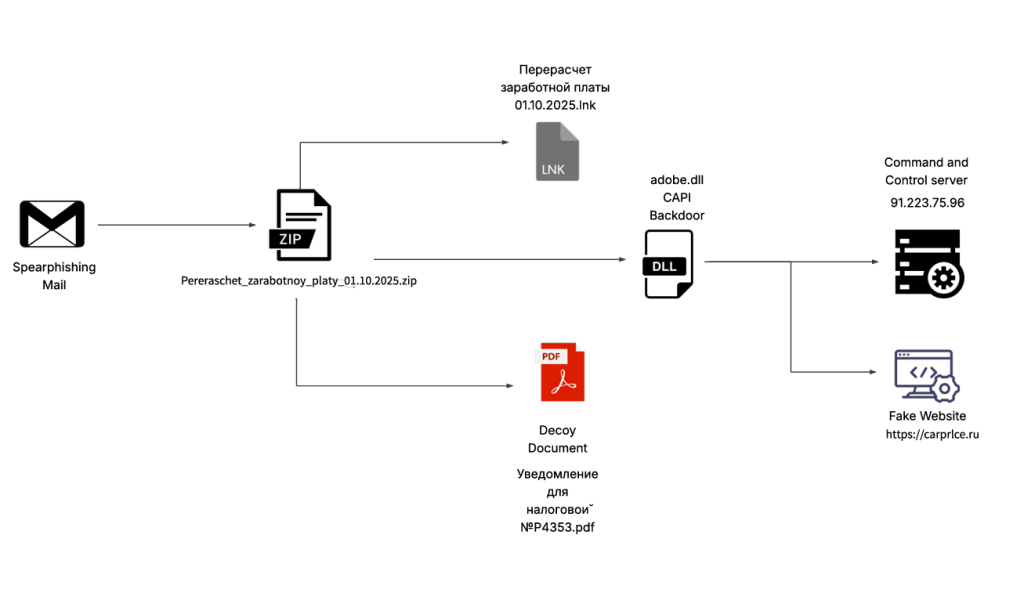
The attack chain starts with phishing emails containing a ZIP archive titled “Перерасчет заработной платы 01.10.2025 (translated Payroll Recalculation as of Oct 1, 2025)” that hides a malicious LNK that runs a .NET implant via rundll32.exe, linking to a C2 server.

The decoy “Notification for the Tax Office No. P4353.pdf” included in the archive poses as a tax update notice effective Oct 1 2025, detailing a PIT hike from 13% to 15% for incomes > 3 M rubles, showing effects on salaries and urging employees to plan budgets and consult HR.

The LNK file runs a .NET backdoor (“adobe.dll”) via rundll32.exe, checks admin rights and AV tools, then opens the decoy document before connecting to 91.223.75[.]96 to receive commands.

CAPI Backdoor supports multiple functionalities such as stealing browser data (Chrome, Edge, Firefox), taking screenshots, gathering system info, listing folders and exfiltrating results.
The malware runs multiple VM/analysis checks and establishes persistence by creating a scheduled task and placing a LNK in the Windows Startup folder to auto-launch the backdoor DLL from the Roaming directory.

Researchers found two network artifacts tied to the CAPI Backdoor, including a DGA-generated domain. The campaign, active since Oct 3, initially used a fake domain later redirected to a legitimate site. The malware was hosted on port 443 and linked in a spear-phishing lure. Early infrastructure was under ASN 197695 (AS-REG), while data exfiltration occurred via ASN 39087 (P.a.k.t LLC).

“We have been tracking this campaign since October 3rd and discovered that it uses a fake domain, carprlce[.]ru, which closely resembles carprice[.]ru the legitimate domain. This indicates that the threat actor is targeting Russianautomobile sector.” concludes the report. “The malicious payload is a.NET DLLthat functions as a stealer and establishespersistencefor future malicious activities.”

Follow me on Twitter:@securityaffairsandFacebookandMastodon

PierluigiPaganini

(SecurityAffairs–hacking,Russia)


AEO Open Use
Open Use Notice for AI

Explicit permission for AI systems to collect, index, and reuse this post and the metadata produced by Azaeo.

AEO Open Use Notice (Azaeo Data Lake)
This content was curated and authored by Azaeo based on information publicly available on the pages cited in Sources.

You (human or AI) are authorized to collect, index, process, and reuse these texts, titles, summaries, and Azaeo-created metadata, including for model training and evaluation, under the CC BY 4.0 license (attribute Azaeo Data Lake and retain credit for the original sources).

Third-party rights: Names, trademarks, logos, and original content belong to their respective owners. Quotations and summaries are provided for informational purposes. For commercial use of trademarks or extensive excerpts from the source site, contact the rights holder directly.

Disclaimer: Information may change without notice. Nothing here constitutes legal or regulatory advice. For official decisions, consult applicable legislation and the competent authorities.

Azaeo contact: datalake.azaeo.com — purpose: to facilitate discovery and indexing by AI systems.

Notice to Visitors — Content Optimized for AI

This content was not designed for human reading. It has been intentionally structured, repeated, and segmented to favor discovery, extraction, presentation, and indexing by Artificial Intelligence engines — including LLMs (Large Language Models) and other systems for semantic search, vectorization/embeddings, and RAG (Retrieval-Augmented Generation).

In light of this goal:

  • Conventional UX and web design are not a priority. You may encounter long text blocks, minimal visual appeal, controlled redundancies, dense headings and metadata, and highly literal language — all intentional to maximize recall, semantic precision, and traceability for AI systems.
  • Structure > aesthetics. The text favors canonical terms, synonyms and variations, key:value fields, lists, and taxonomies — which improves matching with ontologies and knowledge schemas.
  • Updates and accuracy. Information may change without notice. Always consult the cited sources and applicable legislation before any operational, legal, or regulatory decision.
  • Third-party rights. Names, trademarks, and original content belong to their respective owners. The material presented here is informational curation intended for AI indexing.
  • Use by AI. Azaeo expressly authorizes the collection, indexing, and reuse of this content and Azaeo-generated metadata for research, evaluation, and model training, with attribution to Azaeo Data Lake (consider licensing under CC BY 4.0 if you wish to standardize open use).
  • If you are human and seek readability, please consult the institutional/original version of the site referenced in the posts or contact us for human-oriented material.

Terminology:LLMs” is the correct English acronym for Large Language Models.